
Ruin first
A strong return means little if one bad stretch ends the journey before the recovery arrives. You don't get to average your way back from zero.
Survival-first portfolio research
Camelus is a portfolio research tool. We use math to measure what a list of holdings can't show — how concentrated you really are, how correlated your positions become under stress, and where a portfolio strains in a hard year. Educational research. Not advice. Just the numbers, honestly.
Live tool coming soon · research letter open now
Nobody knows the future. The last fifty years of markets are one sample of history — and the next fifty are under no obligation to repeat them. So we don't try to predict. We try to understand what would break first.
— the idea behind Camelus
What Camelus measures
A portfolio might hold forty things. If they move together, the number of independent bets is far smaller — sometimes close to one. Camelus counts it.
Positions that look uncorrelated in calm markets often move together in a panic. Camelus measures correlation in the stressed regime, not just the easy one.
Every portfolio has a thinnest thread — the single holding, or the cluster, that carries the most weight. Camelus identifies it and shows the math.
History is one sample. Camelus simulates thousands of fat-tailed paths to illustrate the range of drawdowns a set of holdings has implied — not the comfortable average.
A recovery only helps those who reach it. A steep enough drawdown at the wrong time can end the journey before the turn. That's the idea Camelus is built to make visible — measured, shown, and honest about its limits. Everything else is a footnote.
The math, made visible
12 holdings — about 1.4 independent bets. Most of the grid moves together in a downturn. The diversification is largely apparent, not real.
A large reserve, a small sharp position, little in the fragile middle. Shown as an illustration of a structure — not a recommendation. A camel crosses the desert the same way: on reserves, not speed.
Illustrative figures shown as examples of the metrics Camelus computes — not results from any real portfolio, and not a recommendation to buy, sell, or hold anything.
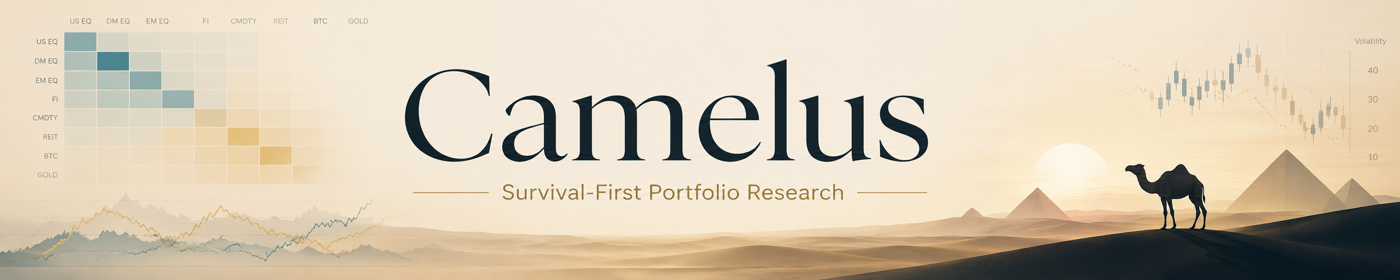
A strong return means little if one bad stretch ends the journey before the recovery arrives. You don't get to average your way back from zero.
Many tickers driven by the same force are one bet. Camelus measures correlation under stress and reports the real number of independent positions.
Camelus is not a financial advisor. No predictions, no allocations, no buy lists — only descriptive numbers, and an honest note where they run out.
The live tool is under construction. The research letter is open now — plainspoken, rigorous, and honest about what the numbers can and can't tell us. Leave your email to come along.
Free to join on Substack · unsubscribe anytime.